Short Agenda — Meeting Cost Meter Agency Site
Meeting Cost Meter Agency Site is a template made in ClickFunnels AI for an agency website. It opens a live taxi-style meeting meter on the home page, prints a cost receipt when the visitor ends the meeting, and sends them to a flat-$390 audit week checkout.
About this template
What is Short Agenda — Meeting Cost Meter Agency Site?
Short Agenda is a nine-person meeting-design firm in Minneapolis, Minnesota. This template gives that firm — or any consultant whose pitch is hidden cost — a complete agency site: a home page with a running money meter, a two-step audit checkout, a confirmation screen, supporting pages, and an owner dashboard. The pitch never mentions ROI in the abstract; it shows a dollar amount climbing in real time.
What you get
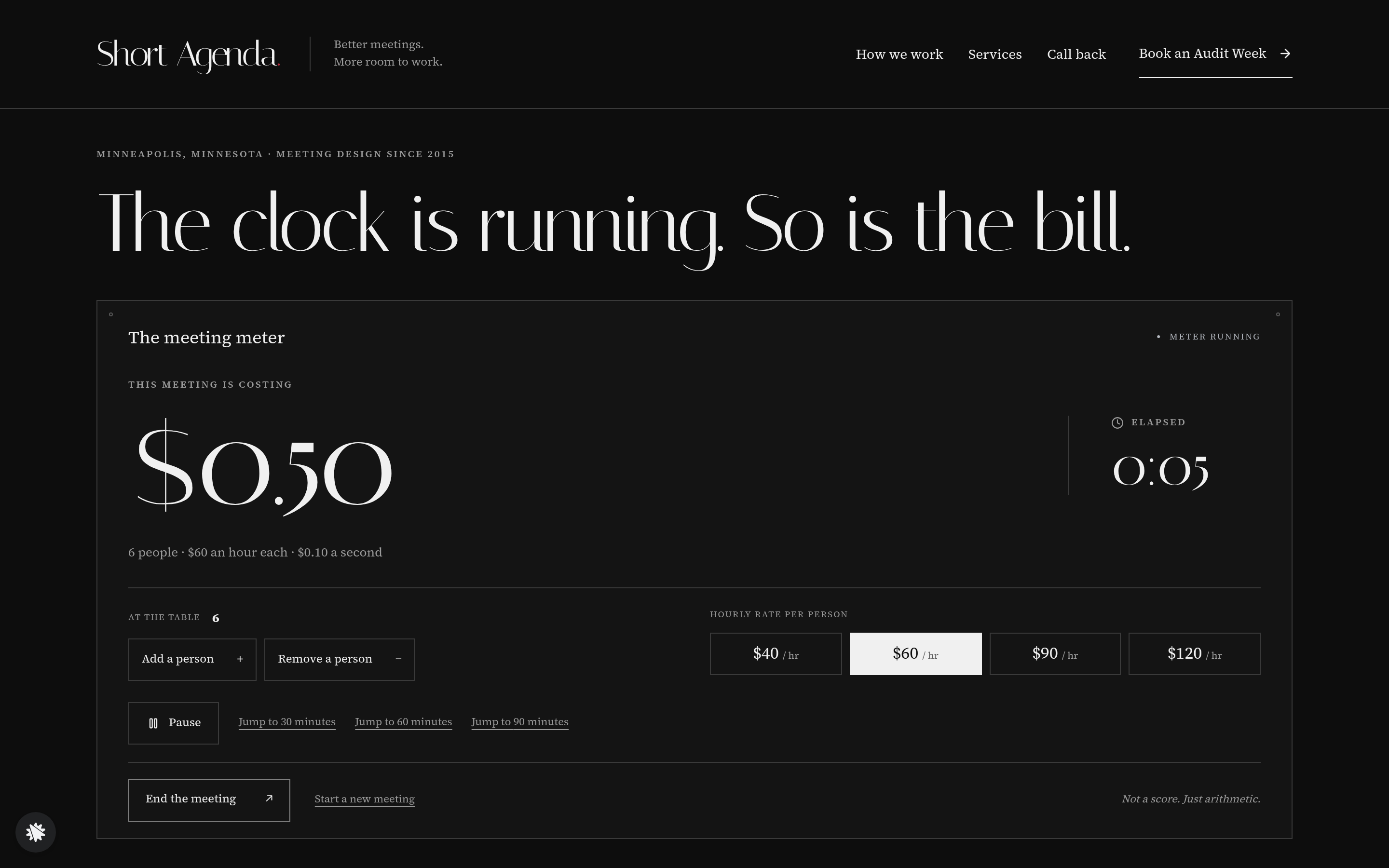
- Index (/) — dark header with the Short Agenda wordmark and a "Book an Audit Week" link; the Meeting Meter hero (large running dollar display, elapsed clock, Add/Remove a person controls, four hourly-rate tiles, Pause/Resume, three jump buttons, End the Meeting, receipt slip, Start a New Meeting); a four-number stat row; the "Your Audit Week in working order" five-day breakdown (Monday calendar pull through Friday redesign session); a what-you-get list; three team-lead quotes; three price bands (Audit Week $390, Redesign Month $2,400, Facilitator on call $950/month); closing call-to-action band.
- Audit (/audit) — two-step form: Step 01 collects team name, work email, team size and a Monday picker showing the next six Mondays; Step 02 takes payment by card, secured, at a flat $390, with an optional $120 fourth-observed-meeting order bump.
- Confirmed (/confirmed) — receipt page listing the booked Monday and each of the five dated days.
- How We Work (/how-we-work) — narrative page covering Short Agenda's outside-view method and calendar-access policy.
- Services (/services) — three services with scoped descriptions and clear prices.
- Call Back (/call-back) and /call-back-received — phone-number form and its confirmation screen.
- Dashboard (/admin) — owner-only funnel report: visit counts, opt-ins, recent contacts and sales table.
- Own 404 — branded not-found screen.
How it works
- Visitor lands on Index; the meter starts immediately at 6 people × $60/hour, counting cents per second.
- They adjust people (2–30), pick a rate tile, use jumps or let it run.
- They click "End the meeting"; a receipt slip slides out showing the meeting cost, the 48-week annual cost and what the same meeting would cost in 25 minutes, then a button: "Audit our meetings — $390".
- That button routes to Audit (/audit), where they complete the team details form and proceed to the secured card checkout.
- Payment clears; Confirmed (/confirmed) shows the five-day schedule.
- Every opt-in and purchase is saved automatically to the built-in database and shows on the owner dashboard at /admin. You do not need an external CRM to begin. To swap the firm name, city, rates, or the meter's default settings, say so in plain language. The template then updates the matching copy, numbers, and layout. Because this is a template you remix rather than build from scratch, you can preview the full visitor flow on desktop and mobile before you touch a single setting.
The signature step
The Meeting Meter on Index is the funnel's entire argument. Six people at $60 an hour is $0.10 a second. Jump to 60 minutes and the display reads $360.00. End the meeting and the receipt prints three lines: This meeting $360.00 · Every week for 48 working weeks $17,280.00 · The same meeting in 25 minutes $150.00. No form gate, no score, no opt-in — just arithmetic, and then a single purchase button.
Who it's for
- Facilitators and meeting-design consultants who want a site that earns attention before the pitch.
- Operations consultants and fractional chiefs of staff whose value proposition is time cost made visible.
- Productivity agencies selling a scoped, fixed-price first engagement.
- Any service firm that wants an interactive cost calculator as its hero and a direct checkout behind it.
Design
- Type pairing
- Italiana display Source Serif 4 body
- Motion
- the amount and the clock tick once a second; the receipt slides out when the meeting ends; reduced-motion: the amount still changes each second with no slide
- Signature screen
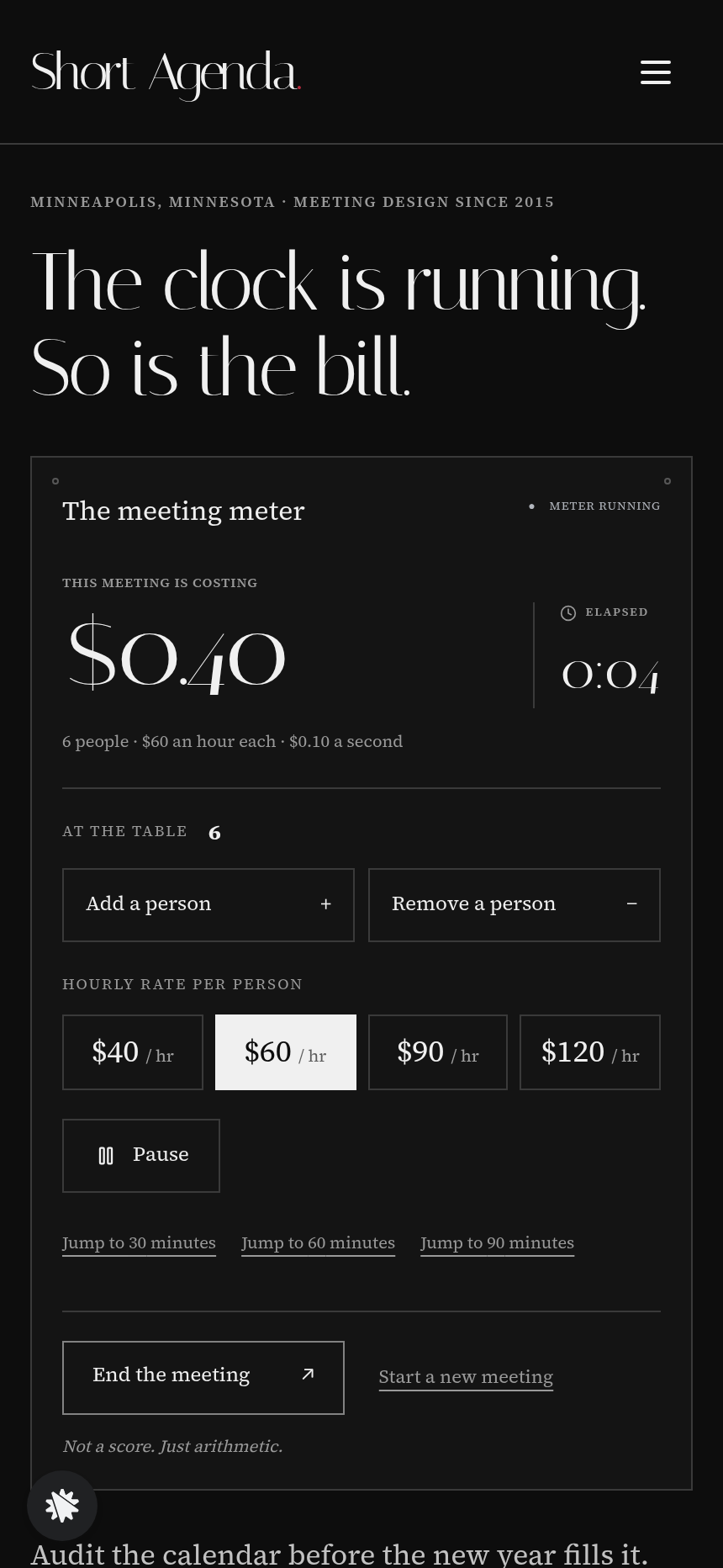
- Meeting meter: a running bill for a meeting with people and rate buttons, time jumps and a printed-style receipt
What can you use Short Agenda — Meeting Cost Meter Agency Site for?
- A freelance meeting facilitator replaces Short Agenda with her own studio name and Minneapolis with her city, sets the default rate tile to $90, and uses the meter as the entire home-page pitch — visitors generate their own cost proof before she asks for anything.
- An operations consultancy selling a fixed-price calendar audit runs paid ads that land on the meter page; the receipt slip's 48-week total is the ad's implied headline, and the 'Audit our meetings — $390' button is the only call to action.
- A fractional chief of staff uses the Call Back page as a lower-commitment entry point for enterprise prospects who want to talk scope before paying, while the $390 checkout handles self-serve bookings from smaller teams.
- A time-tracking software company uses the template to sell a one-week consultant-led meeting audit as a proof-of-value engagement, then upsells its annual subscription on the Confirmed page.
- A HR and culture consultancy customizes the five-day schedule on Confirmed to reflect its own methodology — Monday culture survey, Tuesday and Wednesday observations, Thursday findings, Friday workshop — and publishes the Services page with its three-tier pricing.
- A corporate training firm embeds the meter on a conference landing page, letting attendees run their own meeting-cost calculation live during a session, then books audit weeks directly through the Audit checkout afterward.
Frequently asked questions
What is the Meeting Cost Meter Agency Site template?
Who is this template for?
What pages are included?
How do I customize the Meeting Cost Meter Agency Site in ClickFunnels AI?
Does the template include a checkout or order form?
Can I use my own branding and domain?
How is this different from a classic ClickFunnels agency funnel?
What setup is required before going live?
Related templates
 Agency Sites & Funnels
Second Ring — Answering Service Staffing Calculator Agency Site
Answering Service Staffing Calculator Site is an agency site built in ClickFunnels AI for a live call-answering service. Its Erlang C calculator shows how many phone agents a busiest hour needs, then visitors can start a two-week overflow trial for $149.
 Agency Sites & Funnels
Pickline — Program-the-Picker Warehouse Robotics Agency Site
Pickline Program-the-Picker Agency Site is a ClickFunnels AI template built for Pickline Automation, a Reno, Nevada robotics firm that fits picking robots into warehouses. It opens with a picking-robot tool and leads visitors to book a $450 on-site pick-path audit with a card checkout.
 Agency Sites & Funnels
Cue & Cable — Patch-the-Stage Event Sound Agency Site
Cue & Cable is a five-page agency site for an event sound company in Columbus, Ohio, built in ClickFunnels AI. Visitors patch a stage diagram, answer four questions about their event, pick a planning call, and pay a $150 site-visit deposit.
 Agency Sites & Funnels
Paper Compass — Custom Map Studio Pin-Your-Places Site
Custom Map Studio Pin-Your-Places Site is a studio-site-with-deposit-checkout template built in ClickFunnels AI for illustrated-map studios. Visitors pin places on a drawn town, watch the starting price update, then pay a $95 sketch deposit.
Make this template your starting point.
Inspect the preview, plan your changes, and test the workflow before you share it.
Use this template