Hollis Reed — Family Historian Fan Chart Site
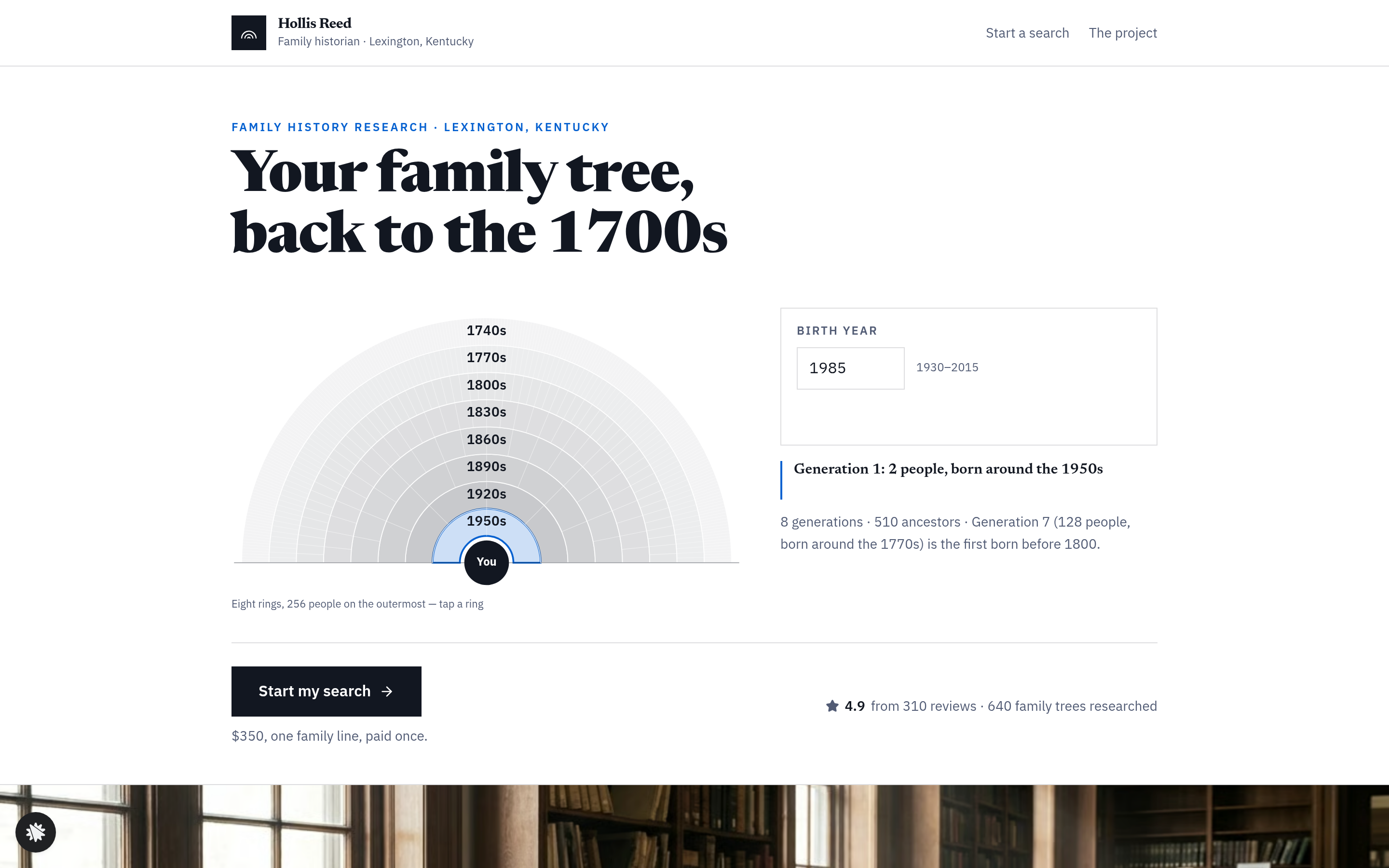
The Family Historian Fan Chart Site is a four-page service funnel built in ClickFunnels AI for a genealogy researcher. The home page draws an interactive fan chart from a birth year, two intake steps gather the research details, and a $350 card checkout closes the sale with an optional $45 framed-chart bump.
About this template
What is Hollis Reed — Family Historian Fan Chart Site?
Hollis Reed researches family history from Lexington, Kentucky. Since 2012 the practice has researched 640 family trees and holds 4.9 stars from 310 reviews. The Family Historian Fan Chart Site turns a visitor's birth year into a picture of their ancestors, then sells one fixed-scope research project for $350. The visitor sees how deep the work goes before they reach the price, and each buyer arrives with a birth year, a side of the family and the oldest name they know.
What you get
Four pages, each with its route:
- The home page (/) holds the fan chart with its birth-year field, a Start my search button, a photo band, a three-step explanation of how a search works, three client quotes, the FAQ and an ask-a-question form that saves name, email and question as a lead.
- The start page (/start) recaps the year and asks for Mother's side or Father's side, the oldest name and place known, and name and email. Each submission is saved as a lead.
- The order page (/order) recaps the choices and takes card payment of $350 for "First four generations, one family line". An optional $45 bump adds a printed, framed 16×20 fan chart.
- The welcome page (/welcome) confirms when research starts and when the report arrives, and asks the buyer to email any extra names, counties or photographs.
How it works
- A visitor types a birth year from 1930 to 2015 on the home page, and the fan chart redraws at once.
- They tap a ring to see that generation's count and birth decade.
- They press Start my search. The year carries to the start page, where they pick a side, name the oldest relative they know and leave their contact details.
- On the order page they pay $350 by card. The framed chart is a checkbox charged in the same payment.
- The welcome page says research begins the next business day, and the report follows six weeks later.
Saved leads and paid orders are held in the built-in database, so the researcher starts with a working list of inquiries.
The signature step
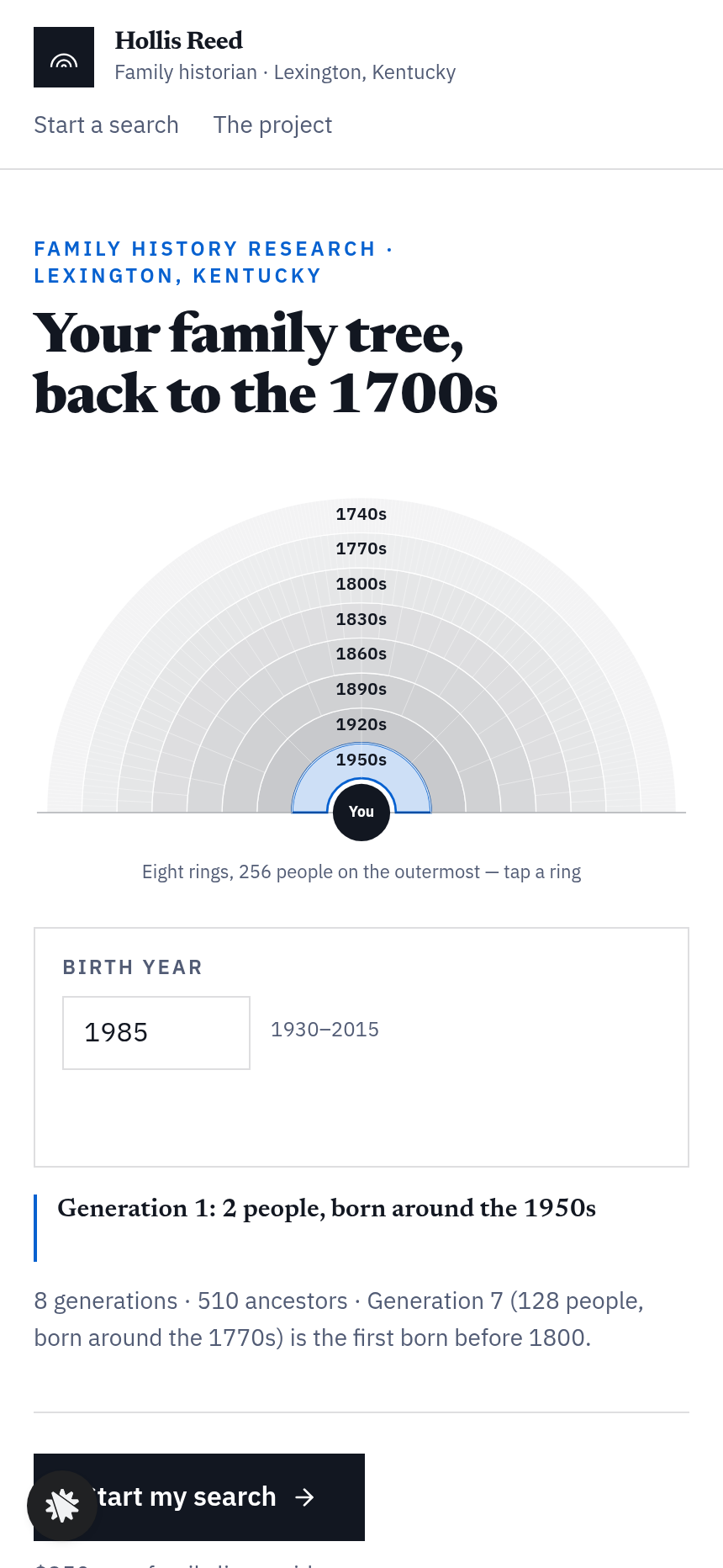
The fan chart is drawn in SVG, not as an image. Its eight rings run from the two parents out to 256 ancestors in the eighth ring. Each ring is a button. For a 1985 birth year, tapping Generation 5 reads "32 people, born around the 1830s", and the summary line reads "8 generations · 510 ancestors · Generation 7 (128 people, born around the 1770s) is the first born before 1800." Each ring's birth decade comes from the birth year less 30 years per generation, so every figure is calculated from the year you entered.
Who it's for
- Genealogists who sell one research package at one price.
- Heritage researchers and archivists who want an intake that gathers the details before checkout.
- Memoir writers and local historians who take on a limited number of client projects each month.
- Anyone selling one deliverable who wants the page to show the depth of the work first.
Design
- Type pairing
- Newsreader display IBM Plex Sans body
- Motion
- rings highlight on tap; chart redraws from the typed year
- Signature screen
- Fan chart from your birth year: eight rings, each a button reading its generation count and birth decade; first generation born before 1800 named
What can you use Hollis Reed — Family Historian Fan Chart Site for?
- A solo genealogist in Lexington sets the price to $350 and keeps the intake to a fixed number of projects each month, asking the builder chat to change the wording once the month is full.
- A heritage researcher who used to take inquiries by email switches to this page, so each lead arrives with a birth year, a side of the family and the oldest name known.
- A family historian who also sells printed heirloom charts keeps the $45 framed bump in the same checkout instead of building a separate product page.
- A memoir writer links the home page from a newsletter, so readers who want research go straight to the two-step intake.
- A genealogy society member adapts the template for a personal site, changing the bio, the questions and the colors before publishing on a domain of their own.
Frequently asked questions
What is the Family Historian Fan Chart Site?
Who is it for?
What pages are included?
How do I customize the Family Historian Fan Chart Site in ClickFunnels AI?
Does it include a checkout or order form?
Can I use my own branding and domain?
How is it different from a classic personal brand funnel?
What setup is required before going live?
Related templates
 Personal Brand
Maren Holt — Line-Up-the-Layers Printmaker Site
Maren Holt — Line-Up-the-Layers Printmaker Site is a ClickFunnels AI product-sales template for a screen printmaker in Duluth, Minnesota. Visitors line up a two-colour print with an interactive registration tool before buying a numbered edition of 50 for a flat $65.
 Personal Brand
Margo Pell — Monday Mini Crossword Personal Site
Margo Pell Monday Mini Crossword Personal Site is a lead-magnet-with-product-sale funnel built in ClickFunnels AI for a crossword maker's personal site. It opens on a playable four-by-four mini, converts solvers into Monday-email subscribers, and sells a $24 book of 52 full-size puzzles.
 Personal Brand
Wren Ashby — Wedding Planner Seating Chart Site
Wedding Planner Seating Chart Site is a lead-capture service funnel built with ClickFunnels AI for wedding planners who sell a flat-rate seating plan — couples arrange 24 guests across three tables, see conflicts in plain language, then pay $85 for the finished chart, place-card list, and drawn table map.
 Personal Brand
Ottilie Marsh — Shape-Your-Pot Potter Commission Site
Potter Shape-Your-Pot Commission Site is a commission-site template made in ClickFunnels AI for studio potters and one-person workshops that take made-to-order work. Visitors use an interactive drawing tool to set four proportions — height, belly, neck and rim — then commission that exact pot for a flat $58 posted.
Make this template your starting point.
Inspect the preview, plan your changes, and test the workflow before you share it.
Use this template